
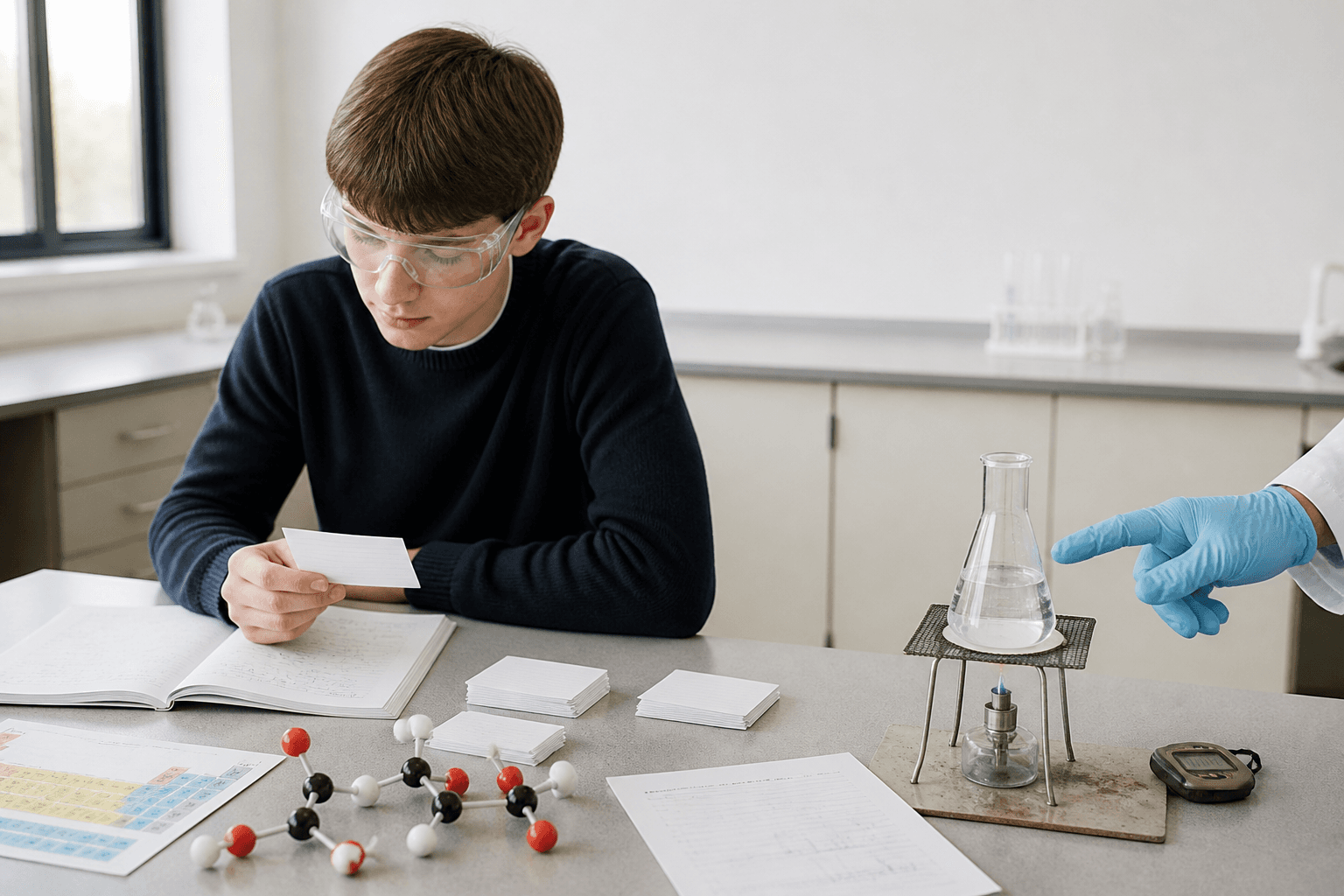
A gcse chemistry revision guide should help you check your exam specification, recall key ideas and practise applying them to questions. Start with your exam board and course, then use notes, flashcards and past papers to find and fix gaps in your knowledge.
Key takeaways
Start your GCSE chemistry revision guide by checking your exam board, course and specification, then use its topic list to plan what to revise.
GCSE Chemistry covers topics such as atomic structure, bonding, chemical reactions and rates of reaction. Your specification shows which details you need to learn and which practical skills you need to use.
Ask your teacher which exam board and course you follow. Check whether you take Combined Science or separate GCSE Chemistry, often called triple science. Also check your tier, as some content is for Higher tier only.
Combined Science includes chemistry alongside biology and physics. Separate Chemistry covers more chemistry content, so a topic list for one course may miss or add material for the other.
Find your exact specification on your exam board’s website. OCR offers different science courses, so check the course name as well as the board. Match your GCSE revision notes and past papers to that specification.
Keep a separate practical skills list alongside your chemistry topics. Your board may call these required practicals or use another name for practical activities.
For each activity, note the method, equipment, safety risks and what the results show. In a reaction-rate experiment, for example, you might change the concentration of an acid and measure how quickly a reaction happens.
Practise explaining how to keep the test fair and why repeating a measurement can help. Exam questions can ask you to apply practical skills to an unfamiliar experiment, not just recall a method.
Work through each specification point and try to explain it without looking at your notes. If you cannot explain ionic bonding or balance an equation, mark it for more practice.
Turn those gaps into questions. StudentNotes.co.uk’s free AI-powered study tools can make flashcards or quizzes from your notes or a YouTube video, saving time on creating practice material. Check the generated answers against your specification and class notes before using them.
Use the guide to creating GCSE revision notes to fix gaps, then test yourself again with a matching past-paper question.
Start with atoms, the periodic table and bonding. Then link chemical changes to rates and energy, and practise calculations alongside each topic.
This order helps you explain reactions instead of just memorising facts. Check your AQA, Pearson Edexcel or OCR specification for your course topics and required practicals. Combined Science covers less chemistry than separate, or triple, science, so check which course you take.
Start with protons, neutrons and electrons. Learn how an element’s position in the periodic table relates to its atomic structure. Then use electron arrangements to explain why elements react.
Move on to ionic, covalent and metallic bonding. For example, sodium transfers an electron to chlorine to form ions. Use that idea to explain why sodium chloride has a high melting point and conducts electricity when molten.
Turn your class notes into questions such as “Why does molten sodium chloride conduct electricity?” Answer without looking, then check and fill gaps in your knowledge. This is active recall. Return to those questions over time for spaced repetition.
Once bonding makes sense, revise reactions of acids, metals and other substances. Practise writing word equations, then balanced symbol equations. Check that each element has the same number of atoms on both sides.
Link reaction rates to particle collisions. Heating a reaction gives particles more energy, so more collisions can lead to a reaction. Compare this with a catalyst, which provides a different reaction pathway.
For energy changes, learn to tell exothermic reactions from endothermic reactions. Exothermic reactions transfer energy to the surroundings. Endothermic reactions take it in. Review your required practicals too. Explain what you would measure, which variables you would control and how you could make results more reliable.
Do calculations as you revise each topic. Do not leave them until the end of your GCSE chemistry revision guide. Use relative atomic masses from the periodic table to find a compound’s relative formula mass. Then practise using moles where your specification requires them.
Show each step and include units. If an answer is wrong, check the formula and arithmetic before trying a similar past-paper question. You can turn calculation methods into prompts with AI flashcards for GCSE revision. Check generated answers against your course materials.
Active recall and practice questions show what you can remember and explain without looking at your notes, so you can find and fix gaps before your GCSE Chemistry exam.
A useful GCSE chemistry revision guide should help you test your knowledge, not just read it. Start with a topic from your course, then answer questions without your notes in front of you.
Change each heading in your GCSE revision notes into a question. For bonding, ask how ionic bonds form, then explain your answer from memory. Check your notes and add anything you missed.
Move from short answers to exam-style questions. For example, explain why increasing temperature can speed up a reaction. Include the idea that particles move faster and collide more often. Check the explanation against your course materials.
StudentNotes.co.uk can turn a document or YouTube video into an AI-generated quiz, saving you time writing questions. Check its questions and answers against your exam board specification before using them. The platform is free for UK students, with no credit card required.
Keep each card focused. Put “What is an isotope?” on one side and the definition on the other: atoms of the same element with different numbers of neutrons.
For equations, practise writing and balancing them rather than only recognising a finished answer. Try hydrogen reacting with oxygen, then check that you have the same number of each atom on both sides: 2H₂ + O₂ → 2H₂O.
Use spaced repetition to revisit cards over time, especially those you get wrong. AI flashcards for GCSE revision can turn your materials into a starting set, but edit unclear cards and check the chemistry. See how to use AI flashcards in revision sessions.
Use past papers and mark schemes from your exam board, such as AQA, Pearson Edexcel or OCR. Pick the right course and tier, then answer without notes before checking the marks.
Do enough past-paper questions to spot gaps and practise fixing them. Keep a note of errors, such as forgetting units or giving an observation instead of an explanation. For required practicals, practise explaining how to control variables and make measurements, then check what the mark scheme rewards.
Choose clear GCSE revision notes for learning, an app that tests your memory, and flashcards made from your own chemistry materials.
Check that each resource fits your exam board, such as AQA, Pearson Edexcel or OCR, and your course. A GCSE chemistry revision guide for separate science may cover content that your combined science course does not require.
Notes help you find the key ideas, but reading them alone is not enough exam practice. After studying bonding, close your notes and explain why ionic compounds conduct electricity when molten but not when solid.
Check your answer, then fix any gaps. Try a past-paper question on the same topic and use the mark scheme to see which points earn marks. Our guide to creating and using GCSE revision notes can help you make notes that are easier to test.
For required practicals, record the method, variables and safety steps. Then practise explaining how you would improve the method or spot a source of error.
Choose GCSE revision apps that make you answer before showing the answer. This is active recall: you bring information to mind rather than just rereading it.
Spaced repetition helps you return to cards over time. Use it for facts such as ion charges, then use exam questions to practise applying those facts in longer answers.
StudentNotes.co.uk offers free AI-powered study tools, including quizzes and flashcards, with no credit card required. Its community library also has student-shared notes. Check any shared notes against your specification and class materials before relying on them.
Upload a document or use a YouTube video to generate flashcards in StudentNotes.co.uk. This saves time making cards by hand and lets you start testing sooner.
For example, turn your notes on acids into a card asking for the products of an acid and a metal. Check the generated answer against your notes, and edit any card that is unclear or covers too much at once.
Add cards for equations too. Ask for the word equation on one card, then practise writing and balancing the symbol equation on paper. See our guide to using AI flashcards for GCSE revision for more ways to build a study session.
Make a GCSE Chemistry revision plan you can keep using by breaking topics into small tasks, checking what you remember and returning to difficult ideas over time.
Start with your exam board’s specification. AQA, Pearson Edexcel and OCR set out the content you need, so check your course and tier before choosing tasks.
Turn each topic into a task with a clear finish. Instead of writing “revise bonding”, plan to explain ionic bonding, draw an ionic compound and answer a question on it.
Use your GCSE chemistry revision guide to find the relevant content, then close it and write what you remember. Check your answer against the guide and add any missing points in a different colour.
Keep a simple record of each task. Note the topic, what you got wrong and what to try next. For example, if you can explain electron transfer but cannot draw the resulting ions, make that drawing your next task.
Mix recall with exam practice. After revising rates of reaction, answer a past paper question on how temperature affects reaction rate. Use the mark scheme to check if you explained the effect on particle collisions, rather than just saying the reaction gets faster.
Leave room for required practicals too. For a practical on making a salt, practise describing the method and explaining why each step is needed. Our guide to creating and using GCSE revision notes can help you turn class work into useful prompts.
Spaced repetition means revisiting a topic after a gap, rather than studying it once and moving on. Combine it with active recall: try to answer from memory before checking your notes.
Make a flashcard that asks, “Why do metals conduct electricity?” On the back, explain that metals have free electrons that can carry charge. If you miss the point, check your notes and bring the card back into a later session.
For chemical equations, practise writing and balancing them without looking. Check that each element has the same number of atoms on both sides, then retry any equation you got wrong.
StudentNotes.co.uk offers free AI-powered study tools that can turn a document or YouTube video into flashcards and quizzes. Use its spaced repetition mode to revisit cards, and check generated answers against your specification and class notes.
Use free GCSE chemistry resources from StudentNotes.co.uk to make study aids, then practise exam questions with your exam board’s past papers and mark schemes.
StudentNotes.co.uk is a free GCSE revision tool with no credit card required. Its AI-powered study tools can turn your class notes or a YouTube video into flashcards and quizzes, saving you time making questions yourself.
For example, upload notes on electrolysis and make cards that ask which products form at each electrode. Check the generated answers against your teacher’s notes and your exam board specification before you learn them.
Use active recall: cover the answer, try to explain it, then check what you missed. Return to difficult cards later using spaced repetition. This gives you more practice on facts you find hard to remember.
The community library also offers student-shared revision notes. Check that a set matches your board and course before using it, and correct any gaps against your own lessons. Read more about creating and using GCSE revision notes.
Notes alone are not enough for exam practice. They help you review content, but questions show whether you can apply it. StudentNotes.co.uk is GDPR compliant and uses UK-hosted servers.
Find free past papers and mark schemes on the AQA, Pearson Edexcel or OCR website. Pick papers for your specification, tier and course: combined science chemistry or separate GCSE Chemistry. Your teacher can help you check which papers match.
Start with a topic you have revised. Answer questions without notes, then use the mark scheme to check your answers. If a question asks you to explain a result, look for each point the mark scheme expects, not just the final answer.
Keep a record of mistakes. For a calculation, show your working and check the units. For a required practical, practise explaining the method, what to measure and how to make the test fair.
There is no set number of papers you need to complete. Do enough to find weak topics, revisit them, and try fresh questions without notes. As your exam approaches, practise full papers under timed conditions.
For more ideas to add to your GCSE chemistry revision guide, see our GCSE chemistry concepts and revision tips.
StudentNotes.co.uk provides free AI-powered study tools for UK students, with no credit card required. Students can use it to make flashcards and quizzes from documents or YouTube videos, saving time when turning chemistry materials into practice questions.
The platform includes active recall and spaced repetition study modes, plus a community library of student-shared revision notes. Check shared notes and AI-generated materials against your exam board specification and class resources. StudentNotes.co.uk is GDPR compliant and uses UK-hosted servers.
Start by checking your exam board specification and identifying the topics you find hardest. A gcse chemistry revision guide can help you plan, but check that its content matches your AQA, Pearson Edexcel or OCR course and your combined or separate science entry.
Use active recall: cover the answer, write the formula or definition from memory, then check it. Revisit cards over time with spaced repetition, and practise using formulae in questions rather than memorising them in isolation.
For each practical, recall the method, equipment, variables, safety precautions and possible sources of error. Practise explaining how a change to the method could affect the results, and check the practicals named in your specification.
Yes. StudentNotes.co.uk can make flashcards from documents or YouTube videos, so you can turn chemistry notes or a revision video into recall practice. Check the cards against your class materials and specification before using them.
Join 1,000+ students using AI to ace their exams
Sign up free and transform your study materials into comprehensive notes, flashcards, and quizzes in seconds
AI-Powered Notes
10 free generations every month
Any Format Supported
PDFs, Word, YouTube, and more
Passionate about helping students achieve their academic goals through effective study techniques and AI-powered learning tools.

Everything UK students need to know for GCSE 2025 exams - from creating revision timetables to mastering exam techniques across all subjects.

Master GCSE Mathematics with our essential study tips and strategies. Unlock your potential and ace your maths exam with confidence!
Explore these AI-generated study notes from our community library on related topics
AQA GCSE Chemistry paper 1 'simple distillation' (foundation/higher & combined/triple)
Exploring the properties of metals, their extraction, and their relative reactivity in chemical reactions.
GCSE NORTES ON CHEMICAL BONDS YEAR 9 LEVEL
Use these exam papers alongside the article to test recall under real exam conditions.
Instant Flashcards
AI-generated Q&A for revision
Progress Tracking
Gamified achievements & streaks
✓ No credit card required • ✓ 100% free forever • ✓ No paid plans